







Most of a useful plan costs nothing. Written contacts, a meeting place, three days of water and knowing how long your fridge keeps food safe protect a household before any equipment does. Buy backup power only once you know what has to keep running.
Your first four decisions
- Know who you are planning for. Include children, older adults, pets, medications, mobility needs, and powered medical devices.
- List the systems that can stop. Electricity, municipal water or a well pump, heat, cooking, refrigeration, internet, and transportation all fail differently.
- Cover three days first. Build a useful 72-hour reserve before stretching toward one or two weeks.
- Choose a meeting and check-in plan. Everyone should know where to go, who to call, and how to reconnect if phones are unreliable.

Record contacts, meeting places and supply locations, then walk through the plan together. A written copy gives the household something concrete to use.
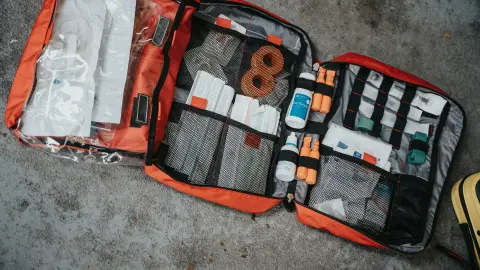
Photo: Jan Kahanek / UnsplashPlan first, then buy: the order that works
Each step below protects the household on its own, and each one tells you what the next purchase, if any, needs to do.
- Write down contacts and a meeting place. Ready.gov's plan starts with how you will contact one another, how you will reconnect if separated and a meeting place that is familiar and easy to find. Use the printed record below.
- Put three days of water aside. CDC's minimum is 1 gallon per person per day, so a household of four needs at least 12 gallons for three days, before pets, heat or illness. The water calculator does the arithmetic and checks container weight.
- Learn the cold-food rules before the fridge goes dark. A closed refrigerator keeps food safe for up to 4 hours; a full freezer holds about 48 hours and a half-full one about 24. Read what to keep and discard from the fridge and the freezer guide.
- Make sure you will hear warnings without the internet. Ready.gov's basic kit lists a flashlight, spare batteries, and a battery-powered or hand-crank radio with a NOAA Weather Radio tone alert. Our weather radio guide explains county alerts.
- Only then size backup power, for what must keep running. Start with powered medical devices, phone charging and the fridge. An average refrigerator-freezer uses about 1.6 kWh a day, according to US Department of Energy figures, so a small power station covers hours, not days. Pick your loads in the power station calculator before comparing batteries.
One-page household checklist
- Size it with the water calculator
- Plan the no-power pantry
- Read the cold-food rules
- Choose lights and batteries
- Use the first-aid checklist
- Compare weather radios
- Plan a warm room
- Fill in the printed record
Complete the water step: start with at least 1 gallon per person per day for 3 days, allowing more for extra needs. Use the household water calculator, check where the containers fit and who can move them, then follow the storage and replacement instructions.
Plan record for your printed copy
- Out-of-area contact
- Meeting place near home
- Meeting place if we cannot get home
- Water: total gallons
- Water: storage locations
- Water: next replacement date
- Medicines that need refrigeration or power
If a supply may be contaminated, read the water treatment safety limits before using it.
Planning sources: Red Cross household planning guidance, Ready.gov family planning guidance, Ready.gov basic kit, CDC emergency water guidance, Ready.gov power outage guidance and the US Department of Energy refrigerator energy FAQ.
Stretching the plan to two weeks
Once three days are covered, the two-week emergency checklist extends the same list. Two things change most:
Water becomes a space question
Two weeks at the CDC minimum is 14 gallons per person, 56 for a household of four. Check where that fits and who can lift it; if it will not fit, keep the three-day reserve and record the gap. Plan the storage space.
Power becomes an energy question
Keeping a fridge running for a day takes about 1.6 kWh, before anything else. Over days, what matters is how much energy you can store and recharge, not the wattage label. Check what a station could run.
If wildfire smoke is a local concern, plan filtration for one room as well.
Common questions
How much should we do at once?
Choose one weak point and improve it this week. A dependable light, three days of water, or a written contact plan is real progress.
Do we need expensive equipment?
No. Start with planning, water, safe light, and the supplies your household already uses. Larger backup systems come after the basics.
Is this a survival plan?
No. It is a household continuity plan for outages, water interruptions, severe weather, and other temporary disruptions.