






A full freezer keeps food frozen for about 48 hours with the door closed; a half-full one, about 24. Keep the door shut and use temperature evidence. Time estimates help you plan; they cannot prove the safety of an individual package. Never taste food to decide whether it is safe.
How long can a freezer stay cold without power?
48 hoursFull freezer
24 hoursHalf-full freezer
4 hoursRefrigerator
Approximate guidance for appliances that were properly cold when power stopped and whose doors stay closed. Food temperature, appliance condition and openings affect the result.
FoodSafety.gov gives approximately 48 hours for a full freezer and 24 for a half-full freezer. These are different from the four-hour refrigerator guideline. Do not apply the freezer timeline to refrigerated meat, milk or leftovers.
Cold food through an outage, step by step
- Up to 4 hoursKeep both doors closed. A closed refrigerator keeps food safe for up to 4 hours.
- At 4 hoursMove fridge perishables to a cooler with ice and keep them at 40°F or below.
- Up to 48 hoursA full, closed freezer holds about 48 hours; a half-full one about 24.
- Longer outagesDry ice for the freezer, or backup power sized to each appliance’s daily energy.
Prepare the cold-food plan while power is available
Keep an appliance thermometer in each compartment. CDC recommends a freezer at 0°F or below and a refrigerator at 40°F or below. Know how to read the thermometers and replace their batteries where applicable. A powered display that turns off during an outage may not provide the information you need.
- Keep frozen gel packs and a cooler available for refrigerated essentials.
- Make an inventory outside the freezer so you can find food without repeatedly opening the door.
- Record the utility outage-reporting channel and a safe alternate storage location, if one is available.
- Find out where you could buy dry ice locally, before you need it.
- Keep shelf-stable meals available so protecting cold food does not leave the household without something to eat.
If you freeze water containers to provide extra cold storage, choose containers intended for freezing and follow their expansion-space instructions. An emergency water container is not automatically freezer-safe. Keep the household's drinking-water reserve accessible separately.

Keep a separate plan for meals that do not depend on cold storage. Choose suitable shelf-stable foods using their labels and your household needs.
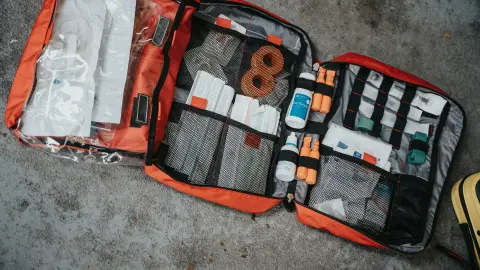
Build the pantry plan Photo: Chris Lawton / UnsplashWhen the power stops
- Write down when it happened. Use the utility's information if the outage began while you were away; record uncertainty instead of assuming the food stayed cold.
- Keep refrigerator and freezer doors closed. Use the pantry plan for meals and avoid opening the freezer simply to check progress.
- Arrange another cold source before you need it. CDC advises moving refrigerated perishables to a cooler with ice at four hours if those supplies are available, keeping the food at 40°F or below.
- Keep people safe. Do not enter floodwater or an electrically unsafe room to rescue food, move a freezer or connect a battery.
Do not turn the time guidelines into a countdown that labels food safe automatically. The time the power was off is only part of the evidence. A door left open, uncertain starting temperature or an earlier interruption changes what you know.
If the outage may run longer than 48 hours
The 48-hour figure is for a full freezer left alone. When the utility's restoration estimate runs past that, or the freezer is only half full, you have three realistic options:
Add dry ice
Ready.gov says 25 pounds of dry ice will keep a 10-cubic-foot freezer below freezing for three to four days. Keep it from touching the food, and wear dry, heavy gloves when handling it.
Move the food
A freezer with power elsewhere, such as a relative's home outside the outage area, keeps the most valuable items safe. Move them while they are still frozen solid and carry them in a cooler.
Run the freezer on backup power
An average freezer uses about 1.5 kWh a day. Check the battery's rated output and startup capacity too; see backup power choices below.
Plan for losses
If none of these is possible, eat perishable food first, keep the door closed and assess each package when power returns. Later cooling does not undo time spent warm.
When power returns: assess the food, not just the display
Check packages before restored cooling hides evidence of thawing. FoodSafety.gov says many frozen foods may be refrozen if they still contain ice crystals or are at 40°F or below, although quality can decline. There are food-specific exceptions. Its chart says to discard ice cream and frozen yogurt even in the ice-crystal column.
| What you know | What to do |
|---|---|
| A frozen package still has ice crystals or is at 40°F or below | Check its food category in the official chart; many foods can be refrozen, with possible quality loss. |
| Food warmed above safe limits, or you cannot establish its condition | Follow the food-specific discard guidance. When in doubt, throw it out; later cooling does not establish what happened earlier. |
| Food may have contacted floodwater | Use CDC's separate flood-food guidance. The outage timeline does not address contamination. |
Do not rely on smell, appearance or tasting as a safety test. For decisions about individual foods, use the official frozen-food chart. This guide does not cover temperature-sensitive medicines or breast-milk storage; follow the appropriate product or health guidance for those.
Does a freezer need a bigger backup battery?
Start with daily energy and the appliance's startup requirements. A freezer's size alone does not give either number. As a planning starting point, US Department of Energy figures put the average freezer at about 1.5 kWh a day, so a 1 kWh power station, with 80% of its capacity usable, covers roughly 12 hours of an average freezer's energy before recharging. Your own freezer may use more or less; measure it with a plug-in energy meter if you can.
The power station calculator checks a freezer against each station's rated output, startup demand and solar recharge, alongside anything else you need to run. Our refrigerator battery guide explains the daily-energy method in more detail.
Compare the researched battery options side by side, then check rated output, usable energy, dry-location requirements and a way to recharge. A larger battery can store more energy; it does not monitor food temperature or certify that a freezer will restart correctly. Keep the food-safety plan even after buying backup power.
Sources and review
Guidance checked September 8, 2026; dry ice and outage guidance rechecked September 30, 2026. The time reference follows federal guidance; equipment-planning questions are editorial guidance, not manufacturer compatibility claims.