




Size the purifier by its smoke CADR, not its advertised coverage. EPA's minimum is a smoke CADR of at least two-thirds of the room's floor area in square feet: 200 cfm for a 15 by 20 foot room. For wildfire smoke, the Association of Home Appliance Manufacturers (AHAM), whose verification seal lists CADR ratings, recommends a smoke CADR equal to the floor area: 300 cfm for the same room. Both figures assume an 8-foot ceiling. Put the purifier in one room you can keep closed and comfortably cool.
Set up a cleaner-air room
EPA recommends a room large enough for the people using it, with few windows and doors and room for the air cleaner. Keep outside windows and doors closed without obstructing an exit. Use the appropriate recirculation settings for your ventilation system and follow the equipment instructions. A window air conditioner, evaporative cooler and central system do not all handle outdoor air the same way.
Run the purifier continuously at the highest setting you can tolerate. Keep its air intake and outlet clear. Avoid creating more indoor particles through candles, smoking, frying or other smoky activities. A quiet sleep setting may be comfortable, but it generally moves less air than the setting used for the published CADR.

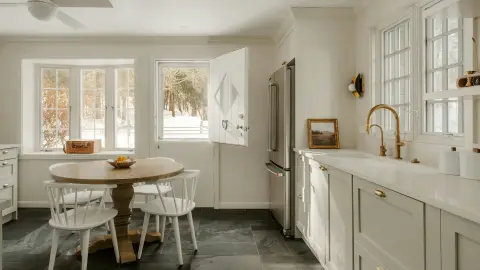
Use your room dimensions when comparing smoke CADR. This photograph illustrates room planning, not a tested cleaner-air setup.
Open the room-sizing calculator Photo: Minh Pham / UnsplashUse smoke CADR as the starting point
CADR is clean air delivery rate, usually expressed in cubic feet per minute. EPA's wildfire guidance sets the minimum: a smoke CADR at least two-thirds of the room's area in square feet. AHAM uses the same two-thirds rule for everyday use but, for wildfire smoke, recommends a smoke CADR equal to the room's area, which gives about 50% more airflow. Treat EPA's figure as the floor and AHAM's as the wildfire target when the budget and noise allow.
Both rules assume an 8-foot ceiling. EPA and AHAM both say to choose a unit rated for a larger area if your ceiling is higher, and open connections to other rooms, heavy leakage and lower fan settings also call for more capacity. These are planning rules, not a promise of a particular indoor pollution level.
| Room area | EPA minimum (area × 2/3) | AHAM wildfire target (area × 1) |
|---|---|---|
| 150 sq ft | 100 cfm | 150 cfm |
| 200 sq ft | 134 cfm | 200 cfm |
| 300 sq ft | 200 cfm | 300 cfm |
| 450 sq ft | 300 cfm | 450 cfm |
| 600 sq ft | 400 cfm | 600 cfm |
Working backward from a label: a smoke CADR of 328 cfm meets AHAM's wildfire target in a room up to 328 sq ft and EPA's minimum up to about 492 sq ft. For other sizes, the room calculator gives both figures.
Look for the smoke CADR on the model's label or certification information. Dust, pollen and a general CADR listing are not automatically identical. Compare units using the same metric and fan setting.
Two larger-room options to investigate
| Option | Manufacturer's airflow figure | What to check before buying |
|---|---|---|
| Coway Airmega 400 | 328 cfm smoke CADR | Exact-model certification, filter-set cost, noise on the setting you will use. |
| Levoit Core 600S-P | 391 cfm general CADR; product page does not separately label smoke CADR | Confirm the smoke-specific figure. Its 606 sq ft figure is stated at 4.8 air changes/hour. |
We use Coway's published smoke figure here rather than treating its one-air-change coverage claim as the area protected during wildfire smoke. Levoit's general CADR is included transparently, not relabeled as a smoke rating. These are research-based candidates for a larger-room comparison; this is not a head-to-head smoke test.
Compare ongoing filter costs as well as the device. Check replacement-filter availability, how pre-filters are cleaned, the exact filter model, and whether the controls let you hold a steady fan setting. A larger purifier may offer useful airflow headroom, but a smaller correctly specified unit can be enough for a smaller closed room.
Know what filtration cannot do
EPA favors mechanical particle filtration and warns against ozone-generating equipment. Verify the exact model's emissions information; an emissions certification does not establish that its airflow is large enough for your room. HEPA or pleated filters target particles. Do not assume an odor-reduction carbon layer removes all wildfire gases, and never use a purifier as a substitute for a carbon-monoxide alarm.
If buying a commercial unit is not feasible, EPA also discusses DIY air-cleaner options and their precautions. Follow its current guidance rather than improvising with damaged fans, obstructed airflow or unsupported electrical arrangements.
A purifier also needs power. If you intend to run one from a portable power station, include its actual power use at the desired fan speed in your backup energy plan. An outage plus smoke plus heat can make staying home impractical even with equipment.
Next: see the indoor-air preparedness hub and include a clean-air destination in your longer-disruption plan.
Primary sources
- EPA: indoor air filtration, sizing and technologies
- EPA: creating a clean room during wildfire smoke
- EPA: guide to air cleaners in the home, sizing table and ceiling height
- AHAM: air filtration standards, the two-thirds rule and the wildfire smoke recommendation
- Coway Airmega 400 specifications
- Levoit Core 600S-P specifications