








A closed refrigerator keeps food at a safe temperature for about 4 hours without power. That is the whole allowance: CDC says to move perishable food to a cooler with ice at the four-hour mark, and to discard perishables that were not kept cold beyond it. Individual foods have their own limits in the FoodSafety.gov chart. Never taste food to decide whether it is safe.
4 hoursRefrigerator
24 hoursHalf-full freezer
48 hoursFull freezer
Guidance for appliances that were at a safe temperature when the power stopped and whose doors stayed closed. Every opening shortens the window.
Why the rule is four hours, not longer
A refrigerator does not have the thermal mass of a full freezer. Once the compressor stops, the air inside warms toward room temperature within hours, and perishable foods spend time in the range where bacteria grow quickly. CDC's threshold is 40°F or below for refrigerated food and 0°F or below for frozen food. An appliance thermometer in each compartment tells you where you actually stand; a powered display that goes dark with the outage does not.
The clock starts when the power goes out, not when you notice. If the outage began while you were away, use the utility's reported start time and treat any uncertainty as time elapsed. If a door was opened, the four-hour window is shorter than four hours.
What to discard once the four hours are up
CDC names the categories: meat, poultry, fish, eggs, milk, cut produce and leftovers. FoodSafety.gov publishes an item-by-item chart with the time and temperature limit for each food. When something is not on this page, look it up in the official chart rather than guessing.
| What you know | What to do |
|---|---|
| The door stayed closed and power returned within 4 hours | Food is generally safe. Check the thermometer; if it reads 40°F or below, carry on. |
| Power was out for more than 4 hours and nothing went into a cooler | Discard perishable food: meat, poultry, fish, eggs, milk, cut produce and leftovers. Later cooling does not undo the time spent warm. Do not add another four-hour allowance; follow the official chart's food-specific time and temperature limits. |
| You moved perishables to a cooler with ice before 4 hours | Keep them cold at 40°F or below; use a thermometer in the cooler and use the food first. |
| Food touched floodwater, or a package leaked | Follow CDC flood-food guidance and discard it. The outage timeline does not cover contamination. |
The financial loss from a full refrigerator is real, but the alternative is foodborne illness during an emergency when medical care may be harder to reach. "When in doubt, throw it out" is the agencies' phrasing for a reason.
What you can usually keep
Some refrigerated items tolerate a warm spell better than others. Hard cheeses, butter, many opened condiments and whole uncut fruits and vegetables are the usual keep examples on the FoodSafety.gov chart, while opened mayonnaise and cream-based dressings are not. Use the chart for the exact list and its time limits rather than treating this paragraph as the rule.

A short inventory outside the appliance means fewer openings during an outage. It also speeds the keep-or-discard decisions afterwards.
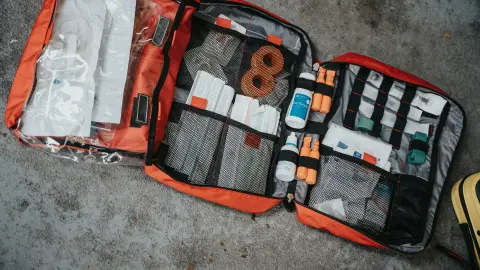
Build a pantry that does not depend on cold Photo: Clay Banks / UnsplashThe cooler plan: buy time before the four hours run out
- Keep the doors closed. Decide meals from the pantry, not from the refrigerator.
- Move perishables at hour four. CDC says that if the power has been out for 4 hours and a cooler and ice are available, put refrigerated perishable food in the cooler. Pack it tight and put a thermometer in it.
- Keep the cooler at 40°F or below. Frozen gel packs, bagged ice or frozen water containers all work; add ice before the temperature climbs.
- Eat the cooler first. Prioritize the most perishable items and cook them fully.
A cooler does not reset the four-hour clock. It only holds food at a safe temperature while it stays cold. If you cannot keep it at 40°F or below, the discard rule applies to the cooler as well.
When is battery backup worth it for a refrigerator?
If outages in your area regularly run past four hours and you keep expensive perishable food, a battery that can run the refrigerator for a day or more changes the plan. Whether a given battery can do that depends on the refrigerator's daily energy and its compressor start-up demand, not on its size. Our refrigerator battery backup guide walks through the arithmetic and includes a runtime calculator. To check a specific station, add the fridge to the power station calculator; it tests rated output and start-up demand as well as energy. The portable power station comparison covers the 1 kWh and 4 kWh options.
Even with a battery, keep the thermometer and the cooler plan. A battery can fail to start a compressor, run out overnight or be needed for something else. The food-safety rules do not change because you own equipment.
Cold food through an outage, step by step
- Up to 4 hoursKeep both doors closed. A closed refrigerator keeps food safe for up to 4 hours.
- At 4 hoursMove fridge perishables to a cooler with ice and keep them at 40°F or below.
- Up to 48 hoursA full, closed freezer holds about 48 hours; a half-full one about 24.
- Longer outagesDry ice for the freezer, or backup power sized to each appliance’s daily energy.
Next: read the freezer outage guide for the 24- and 48-hour freezer rules and what to do when an outage runs longer, then add cold-storage steps to your household checklist.
Sources and review
Guidance checked September 9, 2026. Time and temperature figures follow federal food-safety guidance; equipment questions are editorial planning guidance, not appliance compatibility claims.